Growth and progress aren't the same thing. Here's the trap that catches good owners — and the quiet way out.
You're doing more business than you did last year. You've added people to keep up. And somehow, you're working more hours and keeping less of the money.
If that sounds like your year, you're not failing. You're stuck in a trap that almost nobody warns you about — and the instinct that got you here is the same one keeping you in it.
The short version: To grow your business without hiring, you recover the capacity already trapped inside it — the manual, repetitive work that eats your team's week — instead of adding payroll to paper over it. The catch is that solving a growth problem by hiring makes the business lean on you even harder, which quietly lowers what it's worth. Below: how to spot the trap, plug the leaks, and add output without adding headcount.
Why does hiring feel like the only way to grow?
When demand outpaces your team, the answer feels obvious: hire. Add a coordinator. Add another tech. Add someone to "own" the thing that keeps slipping. It feels like growth. It feels like the responsible move.
But every person you add is a fixed cost that shows up whether the month is good or bad. Every person adds something to manage, train, and route through you. So the work grows, the payroll grows, and the margin doesn't. Revenue goes up in a straight line while the chaos goes up faster.
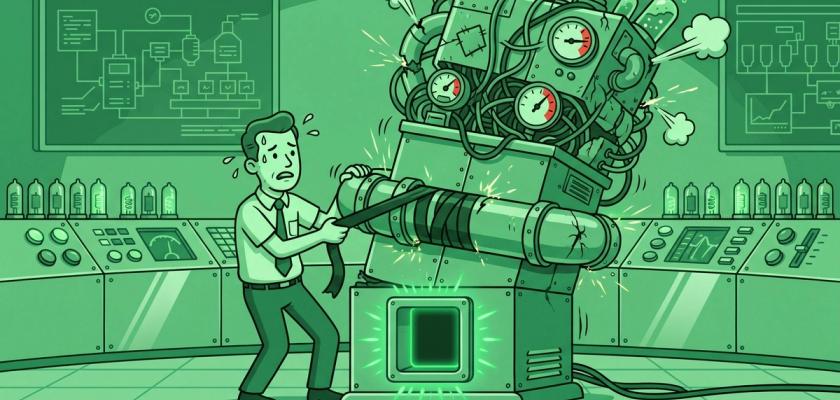
Think of it like driving with the handbrake on. You can get where you're going by pressing harder on the gas — more people, more hours, more effort. But you're burning fuel to fight a brake you can't see. Hiring presses the gas. It never releases the brake.
What is the "scaling trap"?
The scaling trap is what happens when growing revenue requires you to keep adding staff: payroll expands faster than profit, management overhead eats your time, and the business gets more complex without getting more profitable. Operators now track operating leverage — output per person — instead of headcount, precisely to avoid it. Growth that needs more bodies isn't really scaling. It's just getting bigger.
Can hiring actually lower what your business is worth?
Yes. The busier you get by adding people, the more the business runs through you — your head, your relationships, your judgment on every exception. And a business that can't run without the owner is worth less.
When it's time to sell, buyers look at owner-dependent businesses and see risk. They don't see a company; they see a job that happens to have your name on it. Across the M&A data, that dependency shows up as a real discount — owner-dependent businesses routinely sell for 20–40% less than comparable businesses that run on systems and a team. Fewer buyers, lower multiples, longer strings attached.
So the trap costs you twice: today, in shrinking margins and lost weekends — and later, in a payday smaller than the business you actually built.
Is your capacity ceiling a people problem or a systems problem?
It's almost always a systems problem. Most of the capacity you're trying to hire is already sitting inside your business — trapped in work that shouldn't exist.
The same information typed into three different tools — the hidden cost of systems that don't talk to each other. Follow-ups that depend on someone remembering. Approvals waiting on you. Steps that only happen because "we've always done it that way." Across small and mid-sized businesses, knowledge workers lose roughly a full day a week to manual tasks a system could handle. That's not a people shortage. That's leakage.
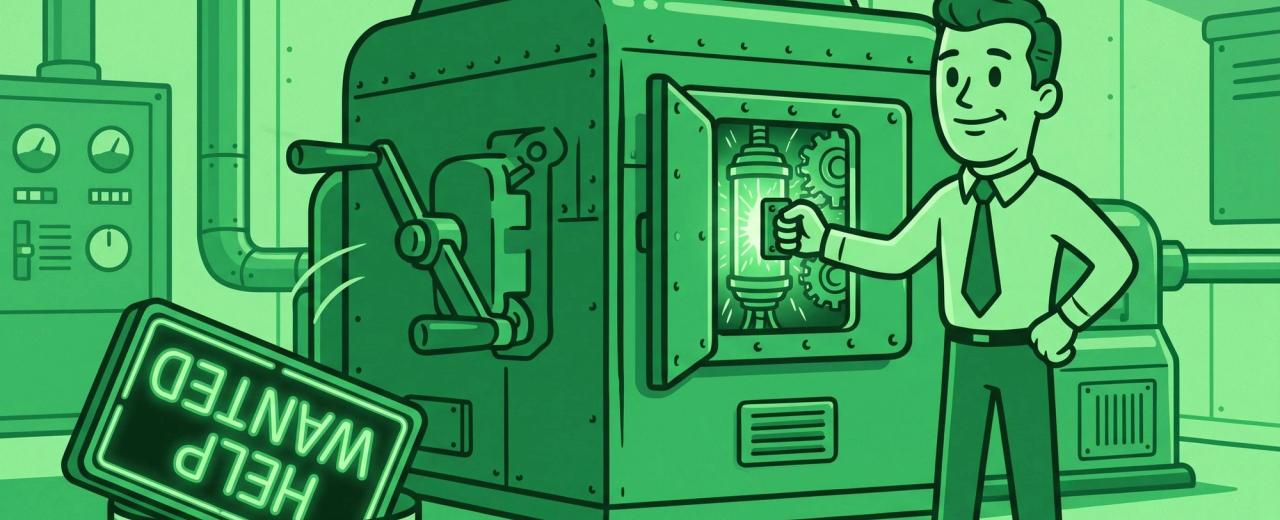
Plug those leaks and the same team does more — without the next salary, without the management overhead, without making the business depend on you even harder. That's the difference between growth that costs you and growth that compounds.
What does growing without hiring look like in practice?
You don't have to take our word for it. Consider a 12-person bookkeeping firm whose story was documented in a 2026 case study.¹ The firm had grown for nine years, adding clients faster than it could add staff. Three bookkeepers spent most of every day on the same grind — downloading invoices and keying vendor names, amounts, and codes into the accounting system by hand. More than 30 hours a week between them, errors creeping in, and month-end closes dragging out to ten or twelve days.
In the owner's words: "We were a bookkeeping firm that spent 70% of our time on data entry." They couldn't grow, because they couldn't hire fast enough.
So instead of hiring, they fixed the leak. They mapped how the work actually moved, standardized the dozens of slightly different versions of the same process, and automated the parts that followed the same steps every time — invoice intake, coding, reconciliation. Manual data entry dropped from about 30 hours a week to 6. Month-end close went from ten-to-twelve days down to three or four.
Here's the part that matters. The firm took on 15 more clients without hiring a single new person — a 38% jump in capacity with the same team. And the bookkeepers, no longer buried in data entry, started actually advising clients — spotting cash-flow issues, reviewing spending. The owner turned that into a new advisory service priced at twice the standard rate. Eight clients signed up in the first quarter.
Same team. More clients. Higher-value work. A better number on every invoice. That's not a hiring story — it's a systems story. (We collect more of these in our client stories.)
How do you grow your business without hiring? (3 steps)
You grow without hiring by recovering capacity in this order:
- Find the leaks. See exactly where time and money are quietly disappearing — in hours and dollars, not vague hunches.
- Get the business out of your head. Turn the steps that live in people's memory into simple, repeatable processes the team can follow without you.
- Make the busywork run itself. The repetitive work happens automatically, correctly, every time — so capacity goes up while cost stays flat.
None of this means tearing down what you've built or stopping the business to fix it. The point is to strengthen what's already working and take the rest off your plate.
What do you gain by scaling without adding headcount?
You get options. Do this, and "more" stops meaning "more of you." The business runs without routing through you — and you get to choose what that buys:
- Grow it — take on more clients with the same team, because chaos no longer caps how much you can handle.
- Step back — work on the business instead of in it. Take the vacation. Survive the resignation.
- Sell it — a systemized business is an asset, not a job, and it commands a better number on the day you sell.
Your call. That's the whole point. (Where you sit in the five stages of small-business growth shapes which of these matters most right now.)
Frequently asked questions
Is it better to hire or automate? Automate first, hire second. If a task is repetitive and follows the same steps every time — data entry, follow-ups, scheduling, reporting — a system does it faster, cheaper, and without error. Hire for work that needs human judgment, creativity, or relationships. The test: if you'd only be hiring someone to do predictable, rule-based work, that's a job for a system, not a salary.
Which tasks should I automate first? Start with the highest-volume, most repetitive work — the tasks that happen the same way dozens or hundreds of times a week. Invoicing, copying data between tools, status updates, and follow-ups are usually the biggest leaks. Pick the one task that, if it vanished tomorrow, would give your team back the most hours. Prove it there, then expand to the next.
Will automating mean laying off my team? Almost never. The common pattern is the opposite: the same people stop doing low-value busywork and move to the work that actually grows the business — sales, service, and judgment calls. The goal isn't doing the same work with fewer people. It's freeing the people you already have to do more valuable work.
How much does it cost to grow without hiring? Far less than the alternative. A full-time hire is a recurring, fully-loaded cost — salary, taxes, benefits, training, and your management time — that repeats every single year. A systemization-and-automation project is usually a one-time build with light upkeep, often a fraction of one salary's multi-year cost — and it doesn't call in sick or quit.
How long until I see results? Quick wins often land in weeks; a single automated workflow can return hours almost immediately. Meaningful, compounding capacity usually shows up within about 90 days, once your highest-leakage processes are documented and automated. The key is sequencing — one process at a time, proven before you move to the next.
Does reducing owner dependency really raise my business's value? Yes. Owner-dependent businesses sell at a 20–40% discount to comparable firms that run on a team and systems, because buyers price in the risk of the owner leaving. Documenting your processes and removing yourself from the day-to-day doesn't just buy back time — it raises the multiple on the day you sell.
The bottom line
The next time work outpaces your team, the question isn't "who do I hire?" It's "what's leaking?" Map where the hours actually go, document the work so it doesn't live in anyone's head, and automate the repetitive steps. You'll often find you already have the capacity you were about to pay for — and a business that's worth more because it no longer depends on you.
Written by Alejandro Morales, Founder & COO of STOA Digital Solutions and Board President of XPX Triangle. STOA helps owner-led businesses run and grow without the owner in the middle. See where your hours and dollars are hiding, explore our operations services, or read more on the STOA blog.
Sources
- Bookkeeping-firm case study — Elevate AI, 2026: https://elevate-ai.ai/case-studies/accounting-firm-automation?utm_source=stoa.agency&utm_medium=referral&utm_campaign=grow-business-without-hiring
- Owner-dependency valuation discount — Icon Business Advisors, 2026: https://iconbusinessadvisors.com/owner-dependent-business-value/?utm_source=stoa.agency&utm_medium=referral&utm_campaign=grow-business-without-hiring
- Manual-work time loss — Frends, State of Integration & AI 2026: https://frends.com/insights/your-employees-are-spending-44-days-a-year-on-work-that-should-not-exist?utm_source=stoa.agency&utm_medium=referral&utm_campaign=grow-business-without-hiring
- The "Scaling Trap" — ERA Solutions, 2026: https://era-solutions.com/the-scaling-trap-how-to-grow-revenue-without-growing-headcount-in-2026/?utm_source=stoa.agency&utm_medium=referral&utm_campaign=grow-business-without-hiring

Written by
STOA Digital
COO & Co-founder of STOA, the tech and software team for small businesses that don't have one. Board President of XPX Triangle.
More about STOA